
FAVN Test for Dogs: Cost, Timeline & Countries That Require It (2026 Guide)
 Marisa Hoskins11 min read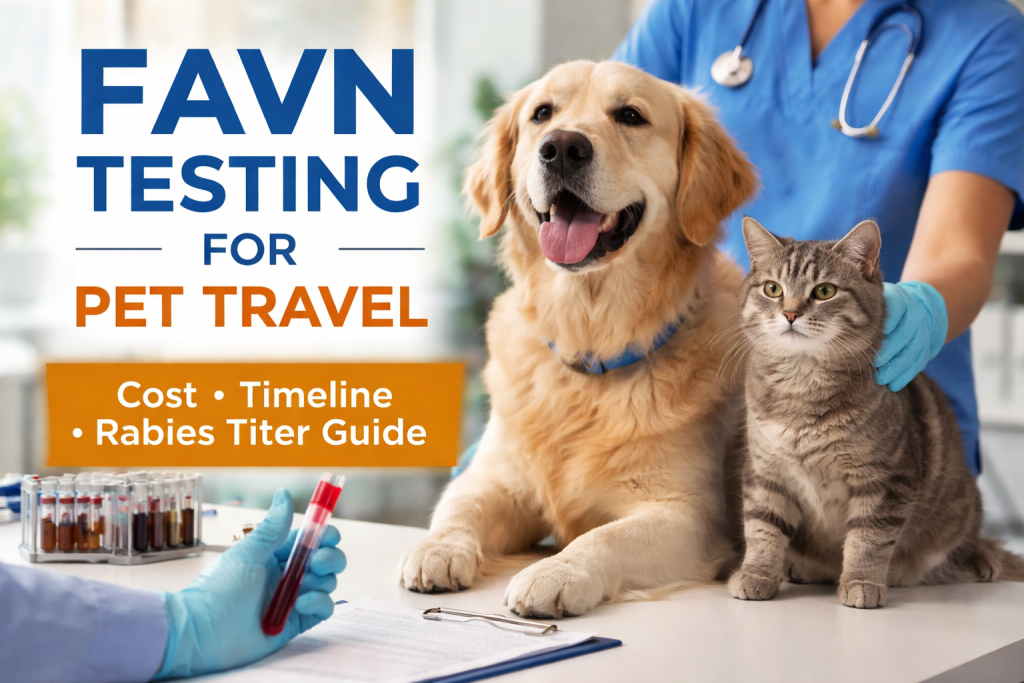
If you’re planning international pet travel to a rabies-free or high-biosecurity destination (think Hawaii, Japan, Australia, New Zealand, Singapore, and some routes into the EU/UK), you’ll likely run into one of the most confusing requirements in pet travel:
FAVN testing.
This guide explains what the FAVN test actually is, who needs it (dogs and cats), where it’s done, how long it takes, what it typically costs, and, most importantly, how to avoid the mistakes that cause expensive delays.
At Paws Abroad, we built our system specifically to prevent FAVN-related delays by turning complex regulations into a clear step-by-step timeline + costing breakdown based on your pet, route, and travel dates—before you book flights or vet appointments.
For the big-picture travel planning view (timelines, documents, airline rules, country-by-country requirements), start here: International Pet Travel Guide 2026
Quick Answer: How much is a FAVN test (2026)?
The FAVN blood test itself has two parts: (1) the lab fee, and (2) what your vet charges for the blood draw, handling, and shipping.
Typical real-world total: $300–$700+ per pet (sometimes higher in major cities), depending on:
- clinic pricing
- shipping method (overnight vs. 2-day)
- whether they bundle it with other travel paperwork
- whether you need a rabies booster + retest
Bottom line: if you’re Googling “how much is a FAVN test” or “rabies titre test cost”, budget a few hundred dollars minimum, and plan early because the timeline is usually the bigger risk than the price.
What is a FAVN test?
A FAVN test (Fluorescent Antibody Virus Neutralization test) is a rabies antibody test that measures whether your pet has a sufficient level of rabies-neutralizing antibodies after rabies vaccination.
People also call it:
- FAVN rabies titer
- rabies titre test
- rabies titer test
- FAVN antibody test
- rabies antibody titration test (common in the EU context)
Passing threshold (most destinations): ≥ 0.5 IU/mL (international standard used by rabies-free/high-control jurisdictions). Hawaii’s import program explicitly uses this threshold and requires specific timing rules.
FAVN vs rabies vaccine: what’s the difference?
- Rabies vaccine = the prevention step
- FAVN testing / rabies titre test = the verification step
Think of it like this: the vaccine is studying, the FAVN rabies titer result is the exam score proving it worked.
Who needs FAVN testing?
Dog FAVN testing (dogs)
Dogs need FAVN testing when the destination requires proof of rabies antibodies (often paired with a mandatory waiting period).
If you’re searching “favn rabies” or “favn rabies titer” for your dog, your destination is likely one of:
- Hawaii (strict rules + waiting period)
- Japan / Australia / New Zealand (high biosecurity)
- Singapore (certain categories/routes)
- EU / UK if entering from specific “unlisted” contexts (Check out our Can I Take My Dog To Thailand guide)
- Hong Kong if entering from specific high risk for rabies countries
- United States if entering from specific high risk for rabies countries
Cat FAVN testing (cats)
Yes cats can get a FAVN test, and many destinations that require it for dogs also require it for cats.
If you’re Googling “favn test for cats” or “rabies titre test cost for cats”, assume the same structure:
- blood draw at your vet
- sample shipped to an approved lab
- same ≥0.5 IU/mL threshold (destination-dependent)
- same potential waiting period rules
Why some countries require a FAVN rabies titer (rabies titre test)
Rabies-free and highly regulated destinations use FAVN testing to reduce the risk of importing rabies through travel. Vaccination records alone don’t prove antibody response—FAVN testing does.
Hawaii’s program is a clear example: it requires a microchip-first sequence, a successful antibody result, and a mandatory waiting period before arrival.
Where to get a FAVN test (and what “approved lab” actually means)
This is the most important clarity point:
You do not “get a FAVN test” at the lab directly like a walk-in blood test.
Instead:
- You go to a veterinarian for the blood draw.
- Your vet ships the sample to an approved lab.
- The lab runs the test and issues the official result.
Hawaii’s import checklist explicitly names approved labs including Auburn University (AU) and Kansas State University (KSU).
If you’re searching “where to get a favn test”, the real answer is:
- Book a vet appointment for the blood draw, then
- confirm which lab is approved for your destination (and whether your vet will ship it correctly).
Paws Abroad tip: this is exactly where people lose weeks wrong lab, wrong destination named on the form, wrong waiting period start date, wrong microchip order. We build the timeline from your route so you don’t find out the hard way.
Auburn FAVN vs Kansas State FAVN: what’s the difference?
A lot of pet parents search “auburn favn” because Auburn is widely referenced in pet travel communities and is recognized in some import programs (including Hawaii’s checklist).
Key practical differences (what matters to you):
- Destination approval: Some destinations are strict about which labs they accept.
- Turnaround time: varies by lab volume and season.
- Paperwork & tracking: labs differ in how they publish/track results.
If your destination is strict (Japan and certain relocation contexts), your vet should confirm the accepted labs before shipping anything.
Step-by-step: how FAVN testing works (the real-world process)
Step 1: Confirm microchip + rabies vaccine timing first
Many destinations require the microchip to be in place before the rabies vaccination and before the test blood draw. Hawaii is explicit: microchip must be implanted before the FAVN rabies antibody blood test is performed.
Step 2: Vet appointment for the FAVN blood test
At your appointment, your vet will:
- scan the microchip (confirm it reads properly)
- confirm rabies vaccination dates
- draw blood and prepare serum for shipping
Step 3: Complete the FAVN report form properly
People commonly search “favn report form” because missing/incorrect form details are one of the top reasons labs reject a sample.
High-risk errors:
- wrong microchip number (one digit off kills your whole process)
- wrong destination listed (Hawaii literally warns to ensure destination is listed correctly)
- missing vet signature
- missing blood draw date
Step 4: Ship the sample to the approved lab
Your clinic usually ships it (overnight or 2-day). This shipping cost is one reason rabies titre test cost varies so much.
Step 5: Lab runs the test + issues FAVN test results
You’ll receive FAVN test results showing the antibody level (IU/mL). Many destinations require ≥0.5 IU/mL.
Step 6: Apply the country-specific waiting period
This is where many people get wrecked: passing results don’t always mean you can travel immediately.
Hawaii requires a minimum waiting period after a successful FAVN rabies antibody test before arrival.
How long does a FAVN test take?
If you’re searching “how long does favn test take”, you need to separate three timelines:
- Vet appointment + shipping time: typically 1–3 days
- Lab processing time: varies (seasonal volume matters)
- Mandatory waiting period: destination-specific (can be 30 days, 90 days, 180 days, etc.)
Example: Hawaii
Hawaii’s Direct Airport Release / 5 Day Or Less program includes:
- successful test result meeting threshold
- minimum 30-day waiting period before arriving
So even if your lab result comes back quickly, you still need to respect the waiting period rules.
Rabies titre test cost: why it adds up
When people ask “rabies titre test cost” or “how much is a FAVN test,” they’re often surprised it isn’t a single flat fee. The total usually includes your vet visit, the blood draw and handling, the lab fee, and shipping sometimes overnight.
In real-world planning, most pet parents spend $300–$700+ per pet, with higher costs in major cities or when retesting is required.
Here’s what typically makes up your total:
Typical FAVN testing cost components
- Vet visit / consult fee (sometimes bundled)
- Blood draw + serum handling fee
- Lab fee (varies by lab)
- Shipping fee (can be meaningful if overnight)
- Admin/document handling (varies wildly by clinic)
Real-world budgeting range: $300–$700+ per pet (higher in expensive metro areas, or if bundled with other travel services).
Common mistakes that delay FAVN testing (and force you to pay twice)
This is where many trips get delayed or derailed:
1) Doing the test too early after rabies vaccination
Antibodies need time to build. If you draw too soon, you risk a low result and a retest.
2) Only one rabies vaccination when two are required
Some destinations require a history of rabies vaccination timing (Hawaii explicitly states dogs/cats must have been vaccinated at least twice for rabies in their lifetime for its program).
3) Wrong lab for your destination
This is where “auburn favn” searches spike—people find a lab name and assume it’s universally accepted. Always confirm destination approval first.
4) Form errors (microchip number mistakes)
A single digit error can invalidate the entire process.
5) Not understanding when the waiting period starts
For Hawaii, the checklist explains how the waiting period is calculated relative to when the approved lab receives the sample.
FAVN testing for international travel: EU / UK note (designated laboratories)
For EU-related rabies antibody titration requirements, there is an official concept of designated laboratories (approved labs that can run the recognized test for EU pet movement rules). The European Commission publishes the list of designated labs.
If you’re traveling to or within the EU/UK context and you’re unsure whether your lab is recognized for your route, verify against the designated laboratory list.
How Paws Abroad helps (without guessing, and without expensive surprises)
FAVN testing is one of those requirements that sounds straightforward until you’re in it and then you discover:
- your vet used the wrong form or wrong destination listing
- your airline route changes and shifts your arrival dates
- you’re suddenly outside the allowed window
At Paws Abroad, we provide:
- personalized costing breakdowns (your exact route + pet + timing)
- a step-by-step timeline that includes FAVN, certificates, endorsements, airline constraints
- mistake-proofing (microchip order, form checks, waiting period logic)
If you’d like to see a complete guide for travelling internationally with your pets check out our International Pet Travel Guide 2026.
And if your route involves flying commercial cargo or summer heat restrictions, this matters too:
FAVN Test FAQs (2026)
Where to get a FAVN test?
This step feels confusing at first, but once the correct lab and form are confirmed, the rest of the process becomes much more predictable.
You get the FAVN blood test drawn at a veterinarian, then the sample is shipped to an approved lab (for example, Hawaii lists Auburn University and Kansas State University as approved options for its program).
The key takeaway: don’t choose a lab based on popularity choose it based on what your destination officially accepts.
How long does a FAVN test take?
Expect:
- days for vet + shipping
- variable lab processing time
- plus a destination waiting period (Hawaii has a minimum 30-day waiting period after a successful test).
Passing results don’t always mean you can travel immediately.
How much is a FAVN test?
Most pet parents pay $300–$700+ total per pet when you include vet fees + lab + shipping. If you fail and need a booster + retest, you may pay it twice.
What are passing FAVN test results?
Most destinations use ≥0.5 IU/mL as the threshold. Hawaii’s checklist explicitly states the result must be ≥0.5 IU/mL.
What is a FAVN report form?
It’s the lab submission paperwork that must match your pet’s identity details (especially microchip number) and destination details. Errors here are one of the most common reasons for delays/rejections.
Can cats get a FAVN test?
Yes. Cats can get a FAVN antibody test, and many rabies-controlled destinations apply the same requirement to cats and dogs. Hawaii’s checklist is explicitly for dogs and cats.
What is “FAVN rabies titer”?
It’s the same concept as a rabies titre test / rabies titer test proof your pet has sufficient rabies-neutralizing antibodies after vaccination.
Do I need FAVN testing for every trip?
Sometimes yes, sometimes no this depends entirely on the destination’s validity rules and whether your rabies vaccination remains continuously valid (no lapses). Always check your destination’s specific policy.
Key takeaways (save this)
- FAVN testing is a rabies antibody test used for international pet travel to strict destinations.
- Dogs and cats may both require it (Hawaii explicitly covers both).
- If you’re searching where to get a FAVN test: it starts at your vet, not the lab.
- If you’re searching how long does FAVN test take: factor lab processing and destination waiting periods (Hawaii has a minimum 30 days).
- If you’re searching rabies titre test cost or how much is a FAVN test: budget $300–$700+ per pet, and plan early.
If your destination requires FAVN testing, planning the timeline correctly is far more important than the test itself.
Discussion
Join the conversation
Share your experiences or ask questions about this article.