Charter Air Travel With Pets (Dogs & Cats) in 2026: Private Jet, Shared Pet Charter & What Actually Matters
 Marisa Hoskins15 min read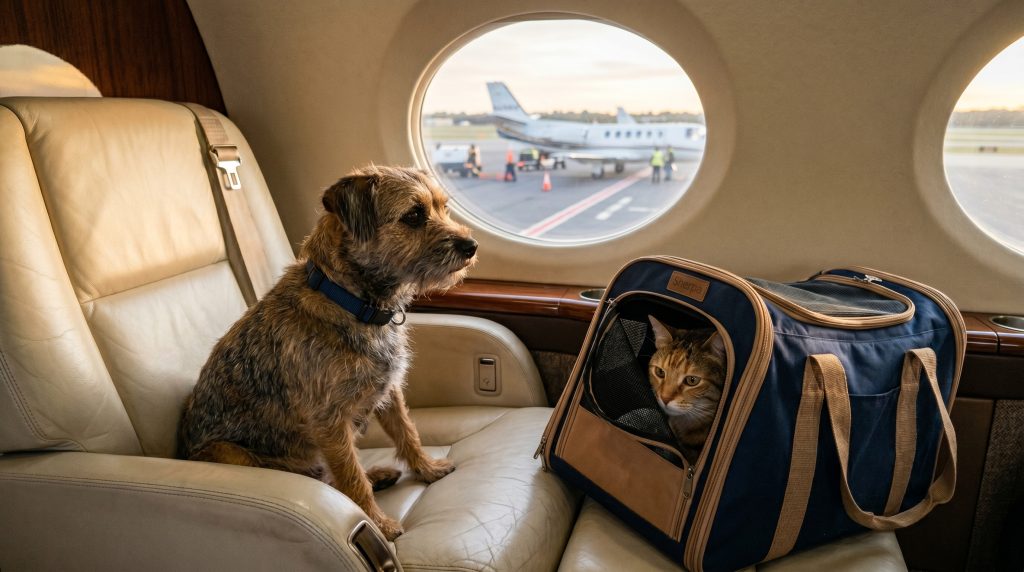
Charter air travel with pets sounds simple on the surface: book a private jet, bring your dog or cat into the cabin, and avoid cargo entirely. In reality, the aircraft is just one piece of a much bigger puzzle that still has to follow destination rules, airline or operator policies, and government regulations.
In 2026, most pet parents look at charter when:
- their dog is too big for commercial cabin.
- cargo is not a safe or allowed option.
- routes or embargoes make commercial itineraries impossible.
Before you sign a contract or wire any money, you need to know which charter model actually fits your pet, your route, and your budget.
This guide walks through:
- full private jet charter with pets.
- shared pet charters and per‑seat models.
- semi‑private options that behave like hybrid commercial–charter.
- when charter makes sense (and when commercial is still better).
Start With Route Finder, Then Choose Your Level of Support
Before you talk to any broker or book a jet, start inside Paws Abroad.
- Use Route Finder to see what matters for your pet and route, including size, cabin or hold, paperwork and timing.
- Then choose how much help you need, from a free Pawsport + Travel Plan to full Concierge.
Charter vs Commercial at a Glance
- Commercial cabin: Usually lowest cost, strict size and route limits, not an option for most large dogs on long‑haul routes.
- Commercial cargo: Often required for larger dogs, but depends heavily on airline, aircraft, and season.
- Shared pet charter: You buy one or more seats on a private jet; pets stay in cabin; cost is shared across travelers.
- Full private jet charter: You charter the entire aircraft; maximum control and flexibility, with the highest cost.
The goal is not “charter at any price,” but finding the safest workable option for your dog or cat on your specific route.
What Is Charter Air Travel With Pets?
Charter air travel with pets refers to flying dogs or cats on:
• A full private jet charter (entire aircraft booked)
• A shared private jet flight with pets (per-seat model)
Typical 2025–2026 pricing:
• US domestic full charter: $5,000–$50,000+
• Transatlantic full charter: $70,000–$120,000+
• Shared US ↔ UK/EU seats: $6,000–$12,000+ per seat
• UK ↔ Hong Kong / Bangkok seats: $20,000+ per seat
Important: Private aviation does not remove import or export requirements. USDA APHIS, EU, and UK rules still apply.
What “Pet Charter” Actually Covers
When people search:
- charter flights for dogs
- pet charter
- charter flights with pets
- chartered flights for pets
- shared private jet flights with pets
- private jet with dog
- flying private with dogs
- private jet with cat
- private pet flights
- pet friendly private jet charter
They are usually describing one of two models.
Model 1: Full Private Jet Charter With Pets
This is traditional private aviation.
You are chartering the entire aircraft. Your dog or cat travels in the cabin with you, subject to operator policy.
You are paying for:
- Aircraft class
- Flight hours
- Positioning
- Handling
- Crew
- Landing fees
You are not paying “per pet.” The aircraft is the cost driver.
2025–2026 Cost Ranges (US Domestic)
Private jets are typically priced hourly.
- Turboprop / smaller aircraft: $1,500–$2,500 per flight hour
- Light jets: $4,000–$5,500 per flight hour
- Midsize jets: $5,500–$8,000 per flight hour
- Heavy / long-range jets: $8,000–$12,000+ per flight hour
Examples:
Los Angeles → San Francisco (1–1.5 hours)
→ $5,000–$12,000 total depending on aircraft
New York → Los Angeles (5–6 hours)
→ $20,000–$50,000+ depending on aircraft and repositioning
Pets typically do not significantly increase the charter price unless there are cleaning surcharges.
Transatlantic Private Jet With Dog or Cat (US ↔ UK / EU)
Transatlantic routes require heavy or long-range jets.
Typical range:
US East Coast → London / Paris / Lisbon
→ $70,000–$120,000+ total charter cost
Factors influencing pricing:
- Aircraft class
- Time of year
- Positioning
- Crew duty constraints
- Fuel
- Routing
For families relocating with multiple dogs or cats, per-pet cost decreases as the aircraft is shared among passengers.
Model 2: Shared Private Jet Flights With Pets (Per-Seat Model)
Shared private jet flights with pets operate differently.
Instead of chartering the whole aircraft, you purchase a seat on a private jet that allows pets in cabin.
This is often what people mean when they search:
- pet charter flights
- charter flights with pets
- shared private jet flights with pets
- private jet pet transport
- pet friendly private jet charter
2025–2026 Per-Seat Pricing
Transatlantic US ↔ UK / EU
→ $6,000–$10,000+ per seat one way
(Some longer sectors exceed $12,000 per seat.)
US domestic shared sectors
→ $4,000–$8,000+ per seat depending on route
Most shared private jet pet flights include:
- One passenger
- One large dog OR multiple smaller dogs
- Cabin-level travel
Cats are typically required to travel in carriers, even on private jets.
Very large dogs may require purchasing an additional seat.
| Route | Full Aircraft Charter | Shared Private Jet Seat |
|---|---|---|
| US Domestic | $5,000–$50,000+ total | $4,000–$8,000+ per seat |
| US ↔ UK/EU | $70,000–$120,000+ total | $6,000–$12,000+ per seat |
| UK /EU↔ Hong Kong | $120,000+ total | $20,000+ per seat |
| UK/EU ↔ Bangkok | $110,000–$150,000+ total | $20,000+ per seat |
Dogs vs Cats on Private Jet Pet Transport
There is a difference in how operators handle species.
Dogs:
- Often permitted loose or semi-restrained in cabin
- Some operators require restraint during taxi, takeoff, and landing
- Very large breeds may need additional space allocation
Cats:
- Almost always required to remain in an airline-approved carrier
- Must be calm and secured
- Cabin environment is generally quieter than commercial
Private aviation tends to be less stimulating than commercial terminals, which can benefit both dogs and cats especially anxious pets.
Important: Private Aviation Does NOT Remove Import Requirements
This is the most important section of this guide.
If you are flying internationally, even on a private jet with your dog or cat, you still must comply with:
- ISO-compliant microchip
- Rabies vaccination timing
- Country-specific health certificate
- USDA APHIS endorsement (for many US exports)
- Approved entry airports
- Border Control Post clearance (EU)
- DEFRA-aligned arrival procedures (UK)
Private aviation changes the flight.
It does not change the law.
If you are exporting from the United States:
→ Read our APHIS Pet Travel Guide
If you are entering the European Union:
→ Review EU Pet Travel Requirements
For broader planning across routes:
→ Visit our International Pet Travel Hub
Check out our My Dog Is Too Big To Fly guide for more pet travel alternatives to cargo.
Entry Airports Matter (This Is Where Mistakes Happen)
Not every private airport can legally receive pets internationally.
For example:
UK arrivals require:
- DEFRA-aligned carriers
- Approved routing
- Proper arrival coordination
EU arrivals require:
- Entry via designated traveler points of entry
- Veterinary inspection process
- Correct health documentation model
Booking a private jet into the wrong airport can result in:
- Clearance delays
- Re-routing
- Financial penalties
- Temporary holding
This is one of the most common issues in private jet pet transport.
Heat Embargo & Why Charter Flights With Pets Appeal
Commercial airlines often impose heat embargo restrictions on pets traveling as checked baggage or cargo.
Private jets typically carry pets in cabin, which often avoids these airline cargo embargo rules.
However:
- Ground temperature still matters
- Handling logistics still matter
- Animal welfare considerations still apply
Charter air travel with pets can be attractive during peak summer months when commercial cargo becomes restricted.
When Charter Flights for Dogs and Cats Make Sense
Charter air travel with pets is typically appropriate when:
- You have multiple large dogs
- Your breed is restricted by commercial airlines
- You are relocating internationally
- You require full schedule control
- You are avoiding cargo entirely
- You value cabin-level supervision
It is rarely chosen for cost savings.
It is chosen for control, welfare, and flexibility.
Not sure if charter is actually the right call for your route, your dog, and your budget?
In 60 minutes you’ll know exactly which flight option makes sense, what your compliance sequence looks like, and what it’s going to cost so you can move forward with confidence instead of second-guessing every decision.
$150 for a 60-minute call. The full $150 is credited toward Concierge if you go ahead.
Stop second-guessing. Get your route mapped. →
Where Charter Pet Travel Usually Goes Wrong
In our experience, problems arise from:
- Incorrect health certificate timing
- Missing USDA endorsement window
- Wrong entry airport
- Assuming private flights bypass paperwork
- Booking aviation before compliance planning
The aviation side is typically handled professionally by brokers and operators.
The regulatory sequencing requires structured planning.
You don’t have to figure this out alone.
One 60-minute call and you’ll leave knowing exactly what needs to happen, in what order, before your pet boards. No more contradictory forums. No more hoping you got it right.
$150 for a 60-minute call. The full $150 is credited toward Concierge if you go ahead.
Book a Personalized Journey Review
Not Sure If You Really Need a Charter?
For some routes, a carefully chosen commercial option is still the best answer. For others, charter is the only realistic way to keep large dogs out of cargo or avoid risky connections.
Use Route Finder to see what matters for your pet and route, then choose the level of help that fits your route and budget.
Choose the Right Paws Abroad Service for Charter Travel
After you’ve checked your route in Route Finder, pick the help that fits your charter plans:
- Free Pawsport + Travel Plan, best if you already have a charter quote and want your pet’s records and your route’s known requirements in one place.
- Personalized Journey Review, a 60-minute call to check your route, endorsement timing and operator choice. $150, credited toward Concierge.
- Concierge, priced for your pet and route, best for complex, high‑stakes, or multi‑pet relocations where you want start‑to‑arrival coordination, including private aviation and arrival‑side logistics.
If your route includes the UK, EU, Asia, a large dog, multiple pets, or brachycephalic breeds, a Personalized Journey Review or Concierge is usually the safest choice.
How We Support Private & Shared Pet Charter Flights
At Paws Abroad, we do not operate aircraft. We handle the planning and compliance layer around your charter or shared pet flight and, when needed, help you book through our partner network.
Through Concierge, we can:
- source full private jet and shared pet charter options for your route.
- map the compliance pathway before you book.
- align USDA, EU, and UK requirements with your chosen dates and airports.
- verify approved airports and arrival procedures with your operator.
- coordinate documents, endorsement, and arrival‑side logistics.
If you’re considering private or shared charter with pets, involve us before you finalize the aircraft. It is far easier to match a flight to a compliant plan than to fix a non‑compliant booking later.
Explore:
Planning Timeline for Charter Air Travel With Pets (International)
Planning Timeline: How to Properly Sequence Charter Air Travel With Pets
If you’re flying domestically within the US, planning is simpler.
If you’re crossing borders, especially US ↔ UK or US ↔ EU — timing, becomes critical.
Below is a realistic planning framework for international private jet or shared pet charter travel.
4–6 Months Before Departure (If Relocating)
This is when you should:
• Confirm microchip compliance (ISO-compatible)
• Review rabies vaccination status
• Identify destination-specific certificate requirements
• Determine entry airport options
• Evaluate full private jet vs shared pet charter models
• Assess seasonal constraints
If you’re not sure where to begin:
→ Start at our International Pet Travel Hub
2–3 Months Before Departure
This is the strategy phase.
You should:
• Confirm final route (US → UK? US → France? US → Portugal?)
• Identify approved arrival airports
• Confirm DEFRA or EU entry point compliance
• Begin flight sourcing (private jet or shared seat)
• Align certificate model requirements
This is also the ideal moment to involve compliance planning.
Because once a charter aircraft is booked, the paperwork clock is running.
30 Days Before Departure
This is where timing precision matters.
You should:
• Confirm health certificate template
• Confirm endorsement requirements
• Verify flight date against certificate validity window
• Confirm arrival airport clearance process
If departing the United States, review APHIS requirements carefully:
→ APHIS Pet Travel Guide
USDA endorsement windows are strict. Private aviation does not extend them.
7–10 Days Before Departure
This is typically when:
• Final veterinary exam is conducted
• Health certificate is signed
• USDA endorsement is submitted (if required)
• Arrival coordination is confirmed
Flight changes at this stage can invalidate documentation.
This is why routing stability matters before endorsement.
Day of Departure
For charter flights with pets:
• Confirm pet restraint policy (dogs vs cats differ)
• Confirm arrival handling
• Confirm microchip scanner availability on arrival
• Ensure all originals are physically onboard
Private aviation may feel relaxed.
Border control is not.
Why the Timeline Matters
With shared private jet flights with pets, you are often operating on a fixed schedule.
With full private jet charter, you have flexibility but regulatory timing still governs:
• Certificate validity windows
• Endorsement processing times
• Arrival inspection availability
The earlier compliance is mapped, the smoother the flight.
Where We Step In
At Paws Abroad, we help you:
• Map compliance before aviation
• Identify viable entry airports
• Coordinate private airline booking
• Align paperwork with routing
• Prevent endorsement timing errors
• Reduce risk of clearance delays
If you’re exploring charter air travel with pets, speak with us before finalizing routing by contacting info@pawsabroad.co
Frequently Asked Questions About Charter Air Travel With Pets
Does flying private with my dog eliminate USDA endorsement?
No. If the destination country requires endorsement, it applies regardless of flight type.
How much does charter air travel with pets cost?
Charter air travel with pets varies significantly depending on route and aircraft type.
Full private jet charter can range from:
- $5,000–$50,000+ for US domestic
- $70,000–$120,000+ for US ↔ UK/EU
- $110,000–$150,000+ for UK ↔ Hong Kong or Bangkok
Shared private jet flights with pets typically range:
- $4,000–$8,000+ per seat (US domestic)
- $6,000–$12,000+ per seat (US ↔ UK/EU)
- $20,000+ per seat (UK ↔ Hong Kong / Bangkok)
The aircraft drives pricing. The pet does not.
Do cats need a carrier on private jets?
In most cases, yes.
Even on private jet pet transport, cats are typically required to remain in an airline-compliant carrier for safety and containment.
Dogs may be permitted loose in cabin during cruise, but policies vary by operator.
Are dogs crated on shared private jet flights with pets?
Usually not during cruise, but policies vary by operator.
Do private jets bypass EU or UK pet travel rules?
No. Entry requirements and documentation standards remain the same.
Is shared private jet pet travel cheaper than chartering an entire aircraft?
Yes. Per-seat shared flights are significantly less expensive than full aircraft charter, but still priced in the thousands per direction.
Are charter flights for dogs affected by airline heat embargo rules?
Private jets typically avoid airline cargo embargo restrictions because pets travel in cabin.
Is charter air travel with pets safer than commercial cargo?
Often yes because pets typically travel in the cabin rather than in the cargo hold.
Private jet travel allows dogs and cats to remain with their owners, reduces handling transitions, and avoids airline cargo systems. For many families, this creates a calmer and more controlled environment.
That said, safety isn’t just about the cabin. Regulatory compliance still governs the journey. Incorrect documentation or entry routing can create far more stress than the flight itself.
Private aviation improves the flight experience. Proper planning protects the arrival.
Is flying private with dogs better for large breeds?
Yes often significantly.
Many commercial airlines restrict large dogs in cabin and require cargo transport. A private jet with a dog allows large breeds to travel in cabin with their owner.
For very large dogs, some shared private jet flights with pets may require purchasing an additional seat.
For multi-dog households, full aircraft charter can be more flexible.
Can I bring multiple pets on a private jet?
Yes.
With a full aircraft charter, you can typically travel with multiple dogs or cats, subject to weight and cabin layout.
On shared private jet flights with pets, the number of animals allowed per seat varies. Some operators allow one large dog or multiple small dogs per seat.
Planning space allocation early is important.
Can I avoid airline breed restrictions by flying private?
Often, yes.
Many commercial airlines restrict certain breeds, especially brachycephalic (short-nosed) dogs.
Private aviation may offer more flexibility because pets are traveling in cabin and not cargo.
However, regulatory import rules still apply regardless of breed.
Can you help book the private airline for us?
Yes. We can coordinate private jet charter or shared pet charter flights through our partner network while managing compliance planning. Contact us at info@pawsabroad.co if you would like support booking a private airline.
Ready to Plan a Charter Flight With Your Pet?
Charter changes the flight. The right plan is what gets your pet home safely.
You’ve done the research. You know charter is the right move. Now you need someone to map the exact compliance sequence, verify your entry airport, and make sure nothing gets missed before that aircraft takes off.
That’s what a Personalized Journey Review is.
60 minutes. A clear plan. No more lying awake wondering if you missed something.
$150 for a 60-minute call. The full $150 is credited toward Concierge if you go ahead.
Discussion
Join the conversation
Share your experiences or ask questions about this article.