
Moving to the UK with a Dog from the US (2026 Complete Guide)
 Marisa Hoskins15 min read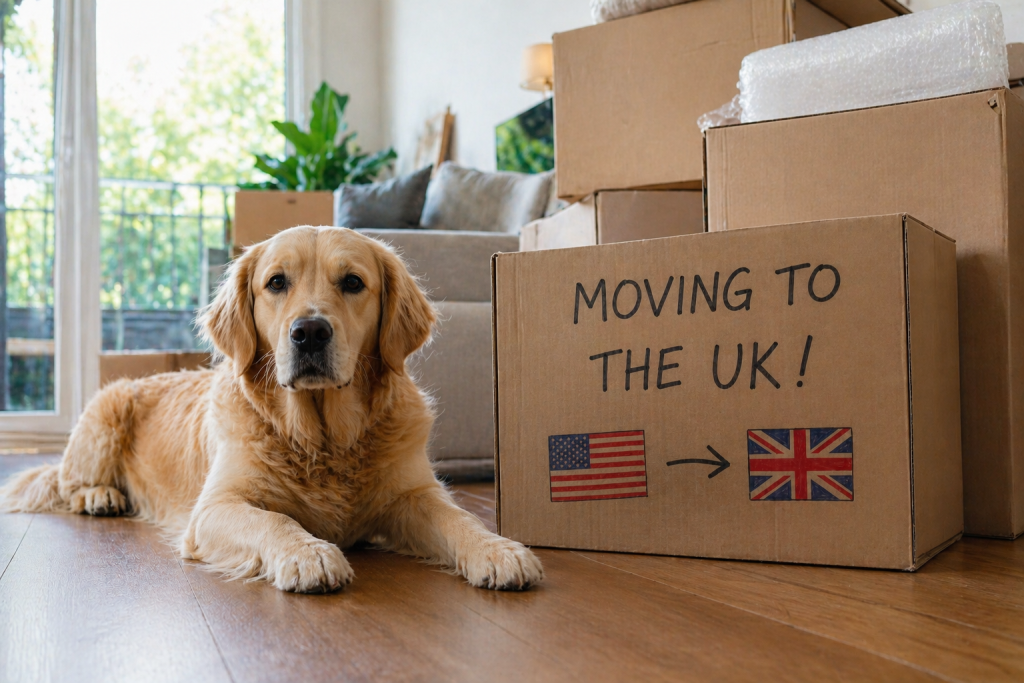
You’ve been Googling this for weeks. Moving to the UK with a dog from the US.
You’ve found three different answers to the same question, one forum post from 2018, and a PDF from APHIS that you’re not sure is still current. Every time you think you’ve figured it out, you find something that contradicts it.
That’s not your fault. US to UK pet travel has more steps, more timing requirements, and more things that can silently go wrong than almost any other international move. But it is doable — and when done correctly, your pet arrives with no quarantine, no detention, and no drama.
This is the guide I wish every client had before they picked up the phone.
Short Answer: Can You Move Your Dog or Cat from the US to the UK Without Quarantine?
Yes.
Dogs and cats can enter the UK from the US without quarantine but only if the requirements are met in the exact correct sequence.
Get one step out of order, miss one window, or use the wrong vet, and your pet could face up to four months of quarantine or be denied entry entirely.
The good news: if you follow the steps below precisely, your pet clears UK customs and comes home with you.
The Most Important Thing Most People Don’t Know
Before we get into the steps, there’s one thing that surprises almost everyone moving from the US to the UK:
No commercial airline allows dogs or cats in the cabin, or as checked baggage, on US to UK routes.
This is not an airline policy issue. It is a UK government requirement.
All pet dogs and cats entering Great Britain (England, Scotland, and Wales) must travel as manifest cargo on an approved route. Your pet gets its own airway bill, is handled by licensed cargo staff, and travels in a temperature-controlled, pressurized hold — but it does not travel with you in the passenger cabin.
This catches families off guard, because US domestic flights allow small pets in-cabin all the time. That option does not exist on this corridor for standard pets.
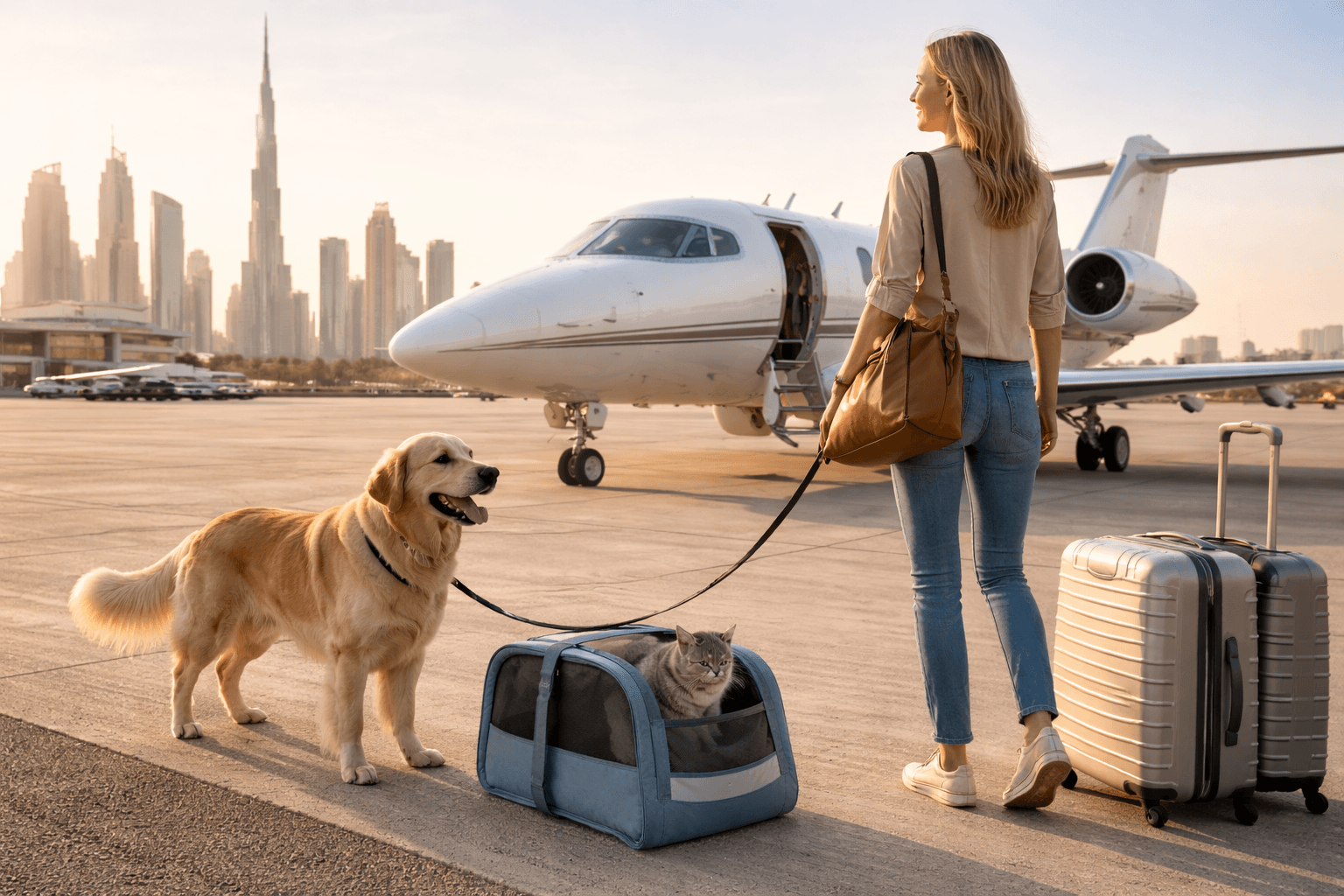
There is a premium alternative: private charter flights that allow pets in-cabin, but cargo is the standard path. More on both options in the flight section below.
Step-by-Step Requirements: Moving to the UK with a Dog or Cat from the US
Step 1: Microchip First — Before Everything Else
Your pet must have an ISO 11784/11785 compliant microchip implanted before the rabies vaccine is administered.
This is not just a formality. If the rabies vaccine was given before the microchip was implanted — or if there’s no record linking the two — the vaccination may be considered legally invalid for UK entry. The microchip number must appear on every piece of documentation that follows.
The chip must be 15 digits and ISO-compliant. Most microchips implanted in the US are compatible, but verify this with your vet before assuming.
Step 2: Rabies Vaccination — After the Chip, Then Wait 21 Days
Once the microchip is confirmed, your pet needs a current rabies vaccination administered by a licensed vet.
Requirements:
- The vaccine must be given after the microchip is in place
- Your pet must be at least 15 weeks old at the time of vaccination
- You must wait at least 21 days after the vaccine before your pet can enter the UK
- The rabies certificate must include the microchip number, vaccination date, vaccine manufacturer, and product name
If your pet already has a rabies vaccine on record, verify it was administered after the microchip was implanted and that it will still be valid on the date of UK arrival. A 3-year booster may not be recognized in the same way confirm with your USDA-accredited vet.
Step 3: Great Britain Pet Health Certificate
Within 10 days of your pet’s arrival in the UK, a USDA-accredited veterinarian must complete the Great Britain pet health certificate.
For most families (5 or fewer pets traveling within 5 days of the owner), this is the non-commercial health certificate. It is:
- Valid for 30 days after the vet signs it
- Must be endorsed by USDA APHIS within 10 days of your pet’s UK arrival date
- Must be accompanied by an Owner Declaration
If your pet is traveling more than 5 days before or after you, or if more than 5 pets are traveling together, a commercial certificate applies with much tighter validity windows (48 hours after signing).
The vet must be USDA-accredited, not just state-licensed. These are two different things. Not every veterinary clinic has this accreditation.
Step 4: USDA APHIS Endorsement
After your vet completes and signs the health certificate, it must be endorsed by USDA APHIS Veterinary Services.
Two options:
- Electronic endorsement: typically 2–4 business days
- Physical (mail-in) endorsement: 5–7+ business days, sometimes longer
Build extra time into your plan. APHIS offices can experience delays, especially around holidays and peak travel seasons.
Once endorsed, your pet must arrive in the UK within 10 days of the APHIS endorsement date.
This 10-day window is non-negotiable. It defines your travel window. Plan your flight booking around it.
Step 5: Tapeworm Treatment — Dogs Only, and the Most Commonly Missed Step
This step is required for dogs only, not cats.
A licensed vet must administer a tapeworm treatment containing praziquantel (or an equivalent approved against Echinococcus multilocularis) within a very specific window:
- No less than 24 hours before your pet arrives in the UK
- No more than 120 hours (5 days) before your pet arrives in the UK
The treatment must be recorded in the health certificate by the administering vet, with the exact date and time noted.
This is the step people miss most often — not because it’s complicated, but because the timing window is easy to miscount, and people forget it needs to happen after all the other paperwork is already in place.
Example: If your dog arrives in the UK at 2pm on a Friday, the treatment must be given after 2pm on Monday (no earlier than 24 hours before) and no later than 2pm on the previous Sunday (no more than 120 hours before). Work this out carefully with your vet.
If your dog arrives past the treatment window due to a flight delay, UK border authorities may require a new treatment before entry is permitted.
Step 6: Approved Route and Cargo Carrier
Not every airline cargo service is approved to carry live animals into the UK, and not every airport is an approved entry point.
Common approved entry airports include London Heathrow, London Gatwick, and Manchester. You and your pet relocation service need to confirm the specific route and cargo handler are on the UK government’s approved list before booking anything.
This is where working with a specialist, rather than booking cargo directly through a general airline, pays off significantly.
Step 7: Arrival Clearance at the Heathrow Animal Reception Centre (HARC) or Equivalent
When your pet lands, it goes to the Animal Reception Centre (most commonly HARC at Heathrow), not the passenger terminal.
Border staff will:
- Scan the microchip and verify it against all documents
- Review the health certificate, APHIS endorsement, and tapeworm record (dogs)
- Confirm all timing windows have been met
If everything is correct and in sequence, your pet is released to you no quarantine required. You will pick your pet up from the Animal Reception Centre, not from baggage claim.
This is where having someone on the ground makes a significant difference. Paws Abroad works with a partner team in the UK who can coordinate your pet’s arrival clearance, liaise with the Animal Reception Centre, and make sure collection goes smoothly even if your own flight lands at a different time.
Timeline: How Far in Advance to Plan
3–6 months out
- Confirm your pet’s microchip is ISO-compliant
- Verify existing rabies vaccination was given after microchip implantation
- If a new rabies vaccine is needed, schedule it now (remember: 21-day wait before travel)
- Identify a USDA-accredited vet in your area familiar with international export certificates
2–3 months out
- Begin researching approved cargo routes and transport specialists
- Do not book flights until your compliance path is confirmed
- Identify your target UK entry airport and verify it is approved
30 days out
- Final vet exam
- Health certificate issued by USDA-accredited vet
- Submit for APHIS endorsement (allow 5–7+ business days for physical; 2–4 for electronic)
- Confirm your travel window based on the APHIS endorsement date
7–10 days out
- Confirm the tapeworm treatment appointment (dogs only) — the vet must administer it within your 24–120 hour window before UK arrival
- Confirm flight details and cargo drop-off logistics
24–120 hours before UK arrival (dogs only)
- Tapeworm treatment must be administered by a licensed vet
- Time and date must be recorded on the health certificate
Common Mistakes That Lead to Quarantine or Denied Entry
These are the errors we see most often — and every one of them is preventable.
Rabies vaccine given before microchip implantation.
The vaccine becomes invalid for UK entry. This requires starting the rabies process over including the 21-day wait.
Missing the tapeworm treatment window.
Either given too early (more than 120 hours before arrival) or not administered at all. UK border staff will catch this.
Using a state-licensed vet instead of a USDA-accredited vet.
Only USDA-accredited veterinarians can issue the Great Britain health certificate. If a non-accredited vet completes the paperwork, APHIS will not endorse it.
Booking flights before confirming compliance.
People book the flight, then try to work the paperwork backward. The APHIS-endorsed health certificate creates your travel window. Everything else must be built around that.
Using an unapproved entry airport or carrier.
Not all cargo services are authorized to bring live animals into Great Britain. Confirm before booking, not after.
Health certificate issued outside its validity window.
The non-commercial certificate is valid for 30 days after the vet signs it. If your travel date shifts and you fall outside that window, you need a new certificate and a new APHIS endorsement.
One Wrong Step Can Mean Quarantine. One Call Prevents That.
Moving your dog or cat from the US to the UK has a lot of steps and the sequence has to be exactly right.
In a Route Review we map your exact compliance timeline, flag any risks in your current paperwork, and tell you exactly what needs to happen before your pet boards.
One wrong step can mean quarantine or denied entry. One call prevents that.
$150 — credited toward Guided or White-Glove Concierge if you move forward.
Flight Options: Getting Your Pet from the US to the UK
Manifest Cargo (Standard)
As covered above, all standard pet dogs and cats must travel as manifest cargo on an approved route.
This means your pet travels in a pressurized, temperature-controlled cargo hold in an IATA-compliant crate. The hold is quiet, the lights are dimmed, and the environment is monitored throughout the flight.
Cargo is the standard path for this corridor. The key is ensuring you use an approved carrier and route and that someone experienced is managing the logistics on both ends.
Some airlines offering cargo pet transport on US-UK routes include British Airways (via IAG Cargo), Air Canada, and American Airlines (via PetEmbark), among others on the UK government’s approved list. Availability varies by route and season, so confirm your specific itinerary with a pet transport specialist.
Private Charter (Premium Alternative)
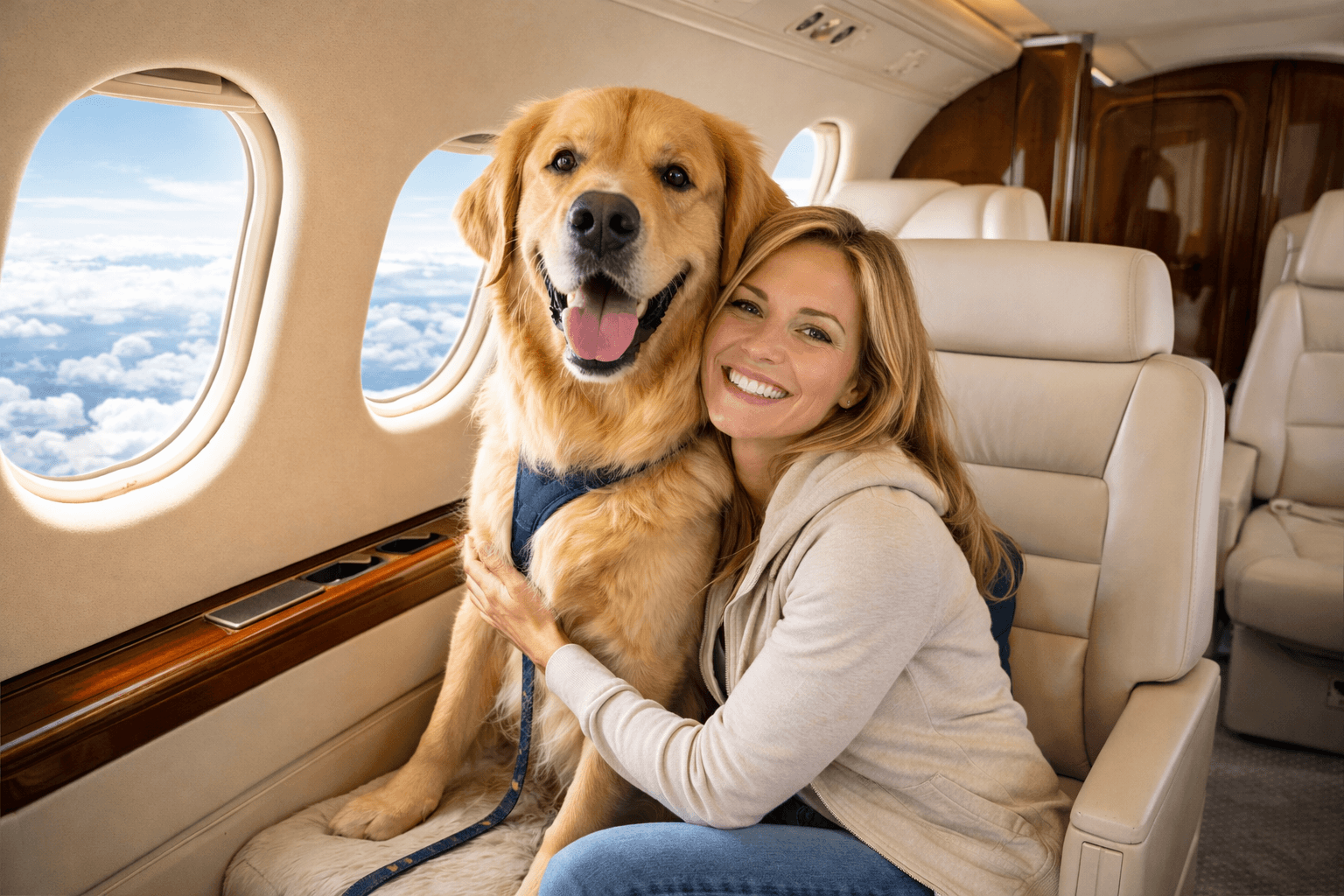
For those who want to travel with their pet in-cabin, private charter is the one route that makes this possible.
Some shared charter operators allow pets in the cabin on US-UK routes. This is a premium option but it removes the cargo logistics entirely and keeps you with your pet for the full journey.
We regularly cover US↔UK routes through our charter network at Paws Abroad.
If you’re considering this option, explore our flight marketplace for current availability on this corridor.
Realistic Costs: Moving a Pet from the US to the UK
| Item | Estimated Cost |
|---|---|
| Vet fees (exam, health certificate, tapeworm treatment) | $300–$600 |
| USDA APHIS endorsement fee | $101–$206 |
| Cargo transport (size-dependent) | $500–$3,000+ |
| Private charter alternative | $6,000–$12,000+ per seat |
| Total (standard cargo move) | $1,000–$4,000+ |
These are estimates. Larger dogs cost more to ship. Last-minute bookings cost more. Working with a relocation specialist typically costs more upfront and prevents the kind of errors that cost far more in the end.
Frequently Asked Questions
Can I bring my dog from the US to the UK?
Yes. Dogs can travel from the US to the UK without quarantine, provided all requirements are met in the correct sequence: ISO-compliant microchip implanted first, rabies vaccine at least 21 days before arrival, USDA-accredited vet health certificate, APHIS endorsement, tapeworm treatment within the 24–120 hour window before UK arrival, and travel via an approved cargo route.
Do dogs need to go in cargo from the US to the UK?
Yes for standard pet travel, all dogs (and cats) entering the UK must travel as manifest cargo on an approved route. No commercial airline permits pet dogs or cats in the cabin or as checked baggage on UK-bound flights. This is a UK government regulation, not just an airline policy. Private charter is the only alternative that allows pets in-cabin.
What vaccinations does my dog need to enter the UK from the US?
A current rabies vaccination is the primary vaccine requirement for UK entry from the US. It must be administered after the ISO-compliant microchip is implanted, and at least 21 days before your pet’s arrival date. The US is a “listed” country under the UK Pet Travel Scheme, which means no rabies antibody titer test is required.
How long does it take to move a dog from the US to the UK?
Plan for a minimum of 3–6 months, particularly if your dog needs a new rabies vaccine (which requires a 21-day wait before travel). If your dog is already microchipped and current on rabies, the health certificate and APHIS endorsement process takes approximately 30 days. Rushing this timeline is the primary cause of compliance errors.
Do I need a USDA health certificate to bring my dog to the UK?
Yes. A Great Britain pet health certificate, completed by a USDA-accredited veterinarian and endorsed by USDA APHIS, is required for all dogs and cats entering the UK from the US. The non-commercial certificate (for 5 or fewer pets traveling within 5 days of the owner) is valid for 30 days after signing and must be endorsed within 10 days of your pet’s UK arrival.
What is the tapeworm treatment requirement for the UK?
Dogs entering the UK from the US must receive a vet-administered tapeworm treatment containing praziquantel no less than 24 hours and no more than 120 hours (5 days) before arriving in Great Britain. The treatment must be recorded in the health certificate with the exact date and time. Cats are not subject to this requirement.
Can my cat travel to the UK from the US in the cabin?
No not on commercial flights. The UK government requires all cats (and dogs) entering Great Britain to travel as manifest cargo on an approved route. In-cabin pet travel is not permitted on UK-bound commercial flights. The only exception is private charter, where some operators allow cats and dogs in-cabin.
How much does it cost to move a dog from the US to the UK?
A standard cargo move typically costs between $1,000 and $4,000+, depending on your dog’s size, the cargo carrier, and whether you use a pet relocation service. Breakdown: vet fees $300–$600, USDA APHIS endorsement $101–$206, cargo transport $500–$3,000+. Private charter with in-cabin pet travel runs $6,000–$12,000+ per seat.
You Don’t Have to Figure This Out Alone
Every step in this process matters. The microchip timing, the 21-day vaccine wait, the APHIS endorsement window, the tapeworm treatment hours there’s no margin for guessing.
But I also want you to know: thousands of families do this successfully every year.
You don’t have to become an expert in UK pet import law. You just need someone who already is.
That’s what we built Paws Abroad for. Our growing community of relocating pet owners uses tools like the Pawsport (your pet’s complete digital record and certificate history) and the Journey Guide (your personalized compliance plan from start to finish) to move through this process with clarity instead of anxiety.
You stop lying awake wondering if you missed something.
You stop Googling the same question five different ways hoping for a different answer.
You just follow the plan and your pet comes home with you.
And when your pet lands, you’re not on your own at the other end either. We work with a partner team on the ground in the UK who can manage customs clearance and Animal Reception Centre coordination so the last step is as smooth as the first.
Ready to Get Your Route Mapped?
Moving your dog or cat from the US to the UK has a lot of steps and the sequence has to be exactly right.
In a Route Review we map your exact compliance timeline, flag any risks in your current paperwork, and tell you exactly what needs to happen before your pet boards.
One wrong step can mean quarantine or denied entry. One call prevents that.
$150 — credited toward Guided or White-Glove Concierge if you move forward.
Discussion
Join the conversation
Share your experiences or ask questions about this article.