Yes, you can bring your dog to Spain from the US, and a dog that meets every entry requirement is not normally quarantined. Your dog needs a microchip first, then a rabies vaccination at least 21 days before travel, then the new EU health certificate from a USDA-accredited veterinarian, endorsed by USDA within 10 days before you land. Your dog must be at least 15 weeks old, and when you arrive you declare it to the Guardia Civil customs office.
If this feels like a lot of moving parts, that’s completely normal. The rules care about order and timing, but once you see the sequence, this trip is very doable, and I’ll walk you through it. If you’d rather not work it out alone, a Personalized Journey Review is a 60-minute call with a specialist about your pet and route. It costs $150, credited toward Concierge if you go ahead.
Last updated: November 2026
What changed in 2026: Updated EU rules for non-commercial dog travel apply from April 22, 2026, covering microchip identification, rabies vaccination timing and how long the health certificate stays valid. USDA requires the new EU non-commercial health certificate from October 1, 2026, and the new commercial certificate from October 17, 2026. An older certificate form is no longer the one to use. Our guide to the 2026 EU pet travel rules covers the April changes in more depth.
Spain Dog Entry Requirements at a Glance
| Requirement | When | Who handles it | Official source |
|---|---|---|---|
| Microchip, or a readable tattoo applied before July 3, 2011 | Before the rabies vaccine | Your vet | MAPA (Spain) |
| Rabies vaccination, dog at least 12 weeks old | At least 21 days before travel | Your vet | European Commission |
| Minimum age of 15 weeks | On arrival | You | MAPA (Spain) |
| EU non-commercial animal health certificate, presented at least in Spanish | Valid 30 days after your vet issues it | USDA-accredited veterinarian | USDA APHIS |
| USDA endorsement, ink-signed and embossed | Within 10 days before EU arrival | USDA APHIS | USDA APHIS |
| Signed owner declaration | Travels with your dog | You or your designated person | USDA APHIS |
| Declare your dog at a designated entry point | On arrival in Spain | You, with Guardia Civil customs | Spanish Tax Agency |
| CDC Dog Import Form for the trip home | Before you return to the US | You | CDC |
This table covers the standard non-commercial trip with your dog. The commercial route and the return trip are explained below.
Who Decides What When You Take a Dog to Spain
Different authorities check different things, and your dog needs a yes from each one.
USDA APHIS (the Animal and Plant Health Inspection Service) controls the US export paperwork: a USDA-accredited veterinarian issues the certificate and USDA endorses it. Spain controls entry. Spain’s agriculture ministry (MAPA) sets the import rules, and the Guardia Civil customs office checks your dog’s documents when you arrive. Your airline controls boarding, with its own weight limits, fees and route restrictions.
When you come home, the CDC decides whether your dog can enter the US. If you’re comparing destinations, our International Pet Travel Requirements guide shows how this split works worldwide.
Step-by-Step: Bringing a Dog to Spain From the USA
Step 1: Confirm Your Trip Is a Non-Commercial Movement
Most families travel under the non-commercial rules, which apply when the trip doesn’t involve selling your dog or transferring ownership. Generally no more than five pets may travel this way. The exception is documented competitions, exhibitions or sporting events involving animals over six months old.
APHIS describes the standard case as you flying on the same flight as your dog, or a designated person traveling with it no later than five days after you. Under the EU rules Spain applies, an authorized person can accompany your dog if your own journey is within five days before or after the dog’s, with the prescribed written declaration.
If nobody can travel with your dog, or your dog changes owner on arrival, the commercial certificate applies instead. That path is much tighter: a USDA-accredited vet must inspect your dog within 48 hours before US departure, and USDA must endorse the certificate within 48 hours after the vet issues it. The rest of this guide follows the non-commercial route.
Step 2: Microchip Before Anything Else
Your dog needs a working microchip before its rabies vaccination, and your vet must scan it before giving the vaccine. This order matters because the vaccine has to be linked to an identified dog: the vaccination must not come before the microchip is implanted or read. A clearly readable tattoo applied before July 3, 2011 is also accepted.
If your dog’s working chip isn’t ISO-compliant, you can carry a compatible scanner or have a second ISO-compliant chip implanted, and both numbers go on the certificate. If the chip doesn’t meet the EU technical standard, you must provide a reader when asked.
Step 3: Rabies Vaccination and the 21-Day Wait
Your dog must be at least 12 weeks old when vaccinated. After a primary vaccination, wait at least 21 days before travel, or longer if the vaccine manufacturer’s immunity period requires it. That’s why Spain doesn’t admit dogs under 15 weeks old: they can’t yet have a valid rabies vaccination.
One US detail catches people out. APHIS treats a primary rabies vaccination given in the US as valid for one year for EU travel, even if it’s a three-year vaccine, and requires a booster within 12 months. Counting on a three-year shot can mean a new primary vaccine and a fresh 21-day wait.
Boosters must be given while the previous vaccination is still valid. If your dog’s latest shot is a booster, bring every rabies certificate showing uninterrupted coverage since the primary vaccination.
Step 4: Get the EU Health Certificate From a USDA-Accredited Vet
Without a valid EU pet passport, your dog needs the EU animal health certificate. Since October 1, 2026, that means the new EU non-commercial certificate. A USDA-accredited veterinarian issues it and USDA endorses it before travel. Certificates from qualifying military veterinarians are the exception: they don’t need USDA endorsement, but they must be issued within 10 days before EU arrival. Our APHIS pet travel guide explains how accreditation and endorsement fit together.
Spain requires the certificate to be officially signed and presented at least in Spanish. It must come with the EU-model declaration and certified copies of your dog’s identification and vaccination records.
Timing is the part to plan carefully. USDA says the non-commercial certificate is valid for 30 days after your vet issues it, and USDA’s endorsement must happen within 10 days before your dog arrives in the EU. Under EU rules, the certificate is valid for 10 days from endorsement until the checks at your first EU entry point, extended by the length of any sea journey. Our EU animal health certificate explainer goes deeper on the document itself.
Step 5: USDA Endorsement and Getting the Original Back
After issuing the certificate, your vet submits it to USDA for endorsement through VEHCS, USDA’s online system. Even if your vet issues it electronically, USDA’s endorsement must be in ink and embossed, and that original must travel with your dog. If USDA returns it by mail, include a prepaid, preaddressed return label with the submission, and allow time for that shipping.
USDA charges $101 per certificate when no lab tests are needed, separate from your vet’s fees. The fee is waived for qualifying ADA service dogs.
Electronic issuance isn’t the last step: plan time to get the ink-signed, embossed original back inside the 10-day window.
Step 6: Sign the Owner Declaration
You, or your designated person, complete and sign the non-commercial declaration, and it travels with your dog and the certificate. It’s a short form, but your document set isn’t complete without it.
Step 7: Arrive and Declare Your Dog
Enter Spain through a designated traveller’s entry point and declare your dog to the Guardia Civil customs office, showing its documents. The Guardia Civil lists contact details for its fiscal and airport service at Madrid-Barajas. A dog that doesn’t meet the rules may be refused entry or quarantined at your expense, returned to its origin, or, as a last resort, euthanized. Every step above exists so this check goes smoothly.
Plan around this: The 10-day endorsement window counts back from when your dog lands in the EU, not from when you leave the US. Plan the vet appointment, the endorsement and the return of the original certificate as one block, working back from the landing date. The certificate must be presented at least in Spanish, so raise it with your USDA-accredited vet when you book.
Timeline: Working Backwards From Your Arrival in Spain
As soon as you start planning
- Confirm the microchip works and was in place before the rabies vaccine
- Check that the rabies vaccination will still be valid on your arrival date, remembering the one-year rule for a US primary vaccination
- Collect every rabies certificate if the latest shot was a booster
At least 21 days before arrival
- Primary rabies vaccination done, or earlier if the manufacturer’s immunity period is longer
When you book flights
- On Iberia, book your dog in the hold no later than 48 hours before departure
- Avoid relying on the hold for Iberia’s Madrid routes to or from Boston, Washington Dulles or San Juan, Puerto Rico
Up to 30 days before arrival
- Your USDA-accredited vet issues the certificate, which USDA treats as valid for 30 days
Within 10 days before arrival
- USDA endorses the certificate in ink with an embossed seal
- The original is back in your hands
Travel day
- Pack the certificate, signed declaration, certified copies and rabies certificates together
Arrival
- Enter at a designated entry point and declare your dog to Guardia Civil customs
If you’d like to see these windows laid out against your own travel date, you can check your dates in Route Finder.
Flying to Spain With a Dog: Cabin or Hold
Even with perfect paperwork, your airline decides whether your dog boards. Here’s how Iberia’s published rules look for its America-zone flights:
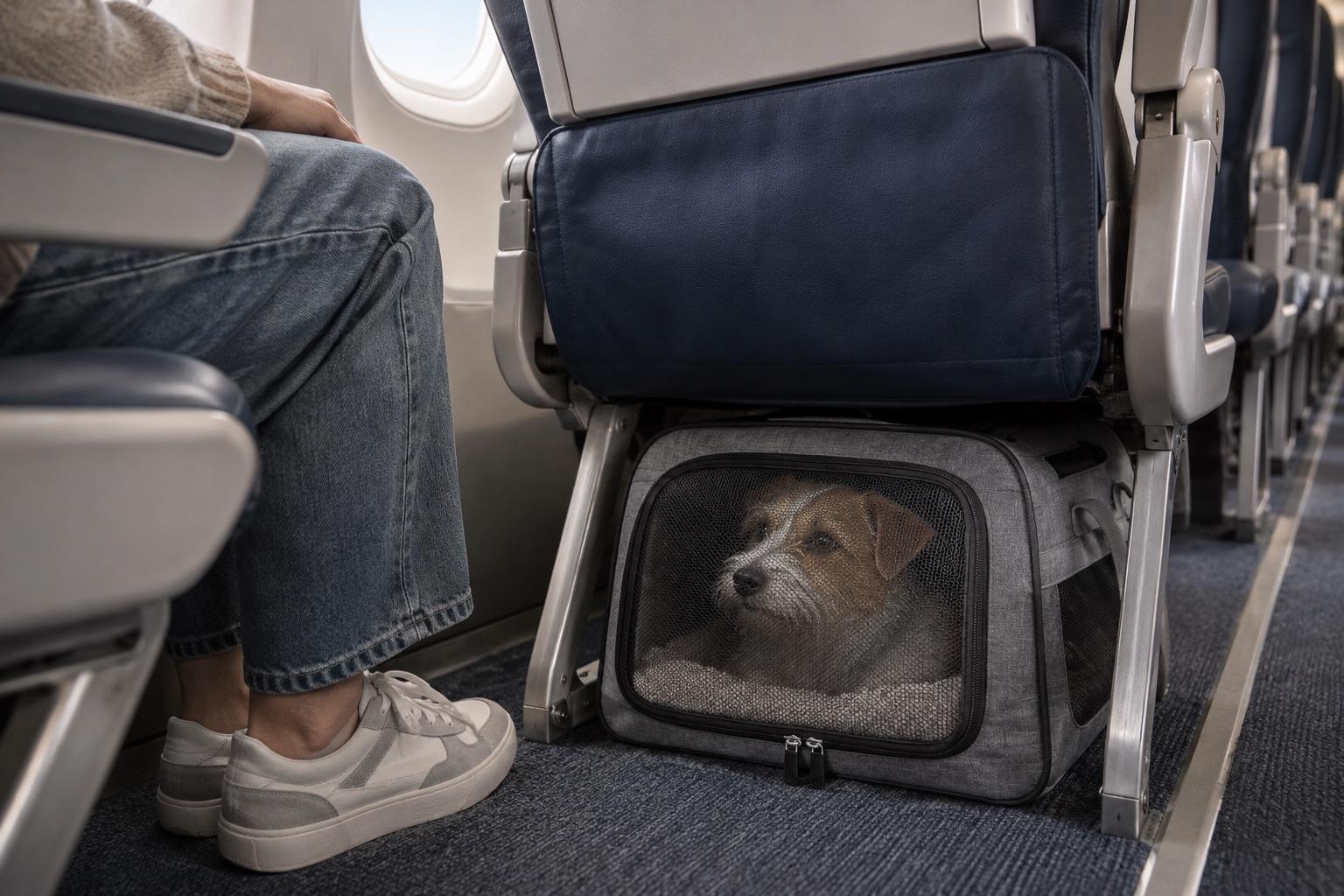
- Cabin: dog and carrier together at most 8 kg (17.6 lbs), subject to availability. The fee is $215 online or $235 at the airport, per direct segment.
- Hold: dog and carrier combined, paid at the airport, per direct segment: $340 up to 10 kg (22 lbs), $365 for 11–25 kg (24–55 lbs), and $390 for 26–45 kg (57–99 lbs).
- Booking: hold pets must be booked at least 48 hours before departure, and Iberia asks for the breed.
- Route limits: Iberia restricts animals in the hold on Madrid routes to or from Boston, Washington Dulles and San Juan, Puerto Rico.
If you’re close to a weight limit: assume you’re over and plan for the next band.
This list covers Iberia only. Other airlines set their own rules, which our airline pet policies guide compares. For bigger dogs, our guide to how large dogs fly walks through the options.
How Much It Costs to Bring a Dog to Spain From the USA
Doing it yourself on a direct flight typically costs about $720 to $980, depending on your dog’s size and whether it needs a new microchip or rabies shot. Here’s how that estimate is built:
- Microchip (if needed): about $20 at one humane society’s low-cost clinic, open only to residents of its service area
- Rabies vaccine (if needed): about $15 at the same clinic, with the same residency limit
- Vet clinic fees: one Ohio clinic lists $65 for the final exam and $290 for certificate paperwork, $355 in total
- USDA endorsement: $101 with no lab tests
- Return shipping for the original certificate: about $50 to $100 for an overnight label, based on one clinic’s estimate
- Iberia fee for one direct segment: $215 in the cabin booked online, or $340 to $390 in the hold
= about $720 to $980 for a typical do-it-yourself trip
This doesn’t include a travel crate, getting to the vet or airport, extra flight segments (Iberia charges per segment) or manifest cargo. Your own vet’s prices may differ from these examples. Our health certificate cost guide explains what drives vet fees.
| Option | What it covers | Cost |
|---|---|---|
| Do it yourself | You book the vet, endorsement and flight yourself | About $720 to $980 (estimate, direct flight) |
| Personalized Journey Review | A 60-minute call with a specialist about your pet and route; the fee is credited toward Concierge if you go ahead | $150 |
| Concierge | We coordinate the whole journey, with a clear scope and price before you commit | Custom quote |
To see which of these costs apply to your dog and your dates, you can run your trip through Route Finder.
Common Mistakes When Taking a Dog to Spain
- Vaccinating before the microchip. The vaccination can’t come before the chip, so you’d need a new vaccine and a fresh 21-day wait.
- Treating a three-year vaccine as three years. For EU travel, a US primary vaccination counts for one year.
- Counting the 10 days from departure. The endorsement window runs to your dog’s arrival in the EU, so a long itinerary eats into it.
- Traveling with a copy. The ink-signed, embossed original must be with your dog.
- Leaving old rabies certificates at home. If the latest shot is a booster, you need proof of uninterrupted coverage.
- Assuming the hold is open on every route. Iberia restricts hold animals on Madrid routes to or from Boston, Washington Dulles and San Juan, Puerto Rico.
- Sending your dog separately on a non-commercial certificate. An unaccompanied dog needs the commercial certificate and its 48-hour windows.
The paperwork mistakes can lead to refused entry or quarantine at your expense. Every one of them is preventable with the timeline above.
Where Your Dog Can Arrive in Spain
Your dog must enter through a designated traveller’s entry point. These include Madrid-Barajas and Barcelona airports and the seaports of Algeciras and Barcelona, along with other listed airports and ports. MAPA keeps the current list with operating hours, so look at it before you book.
If you connect through another EU country, the documentary and identity checks happen at your first EU entry point, and the certificate’s 10-day validity runs until those checks.
Living in Spain With Your Dog: Welfare Rules and Potentially Dangerous Breeds
Once you live in Spain, national animal welfare law applies. You must not leave your dog unsupervised for more than 24 consecutive hours. You must provide necessary and legally mandatory health care and the vet examinations set by regulation, and report loss or theft within 48 hours. You must also prevent uncontrolled breeding, because breeding is reserved for registered responsible breeders.
Some dogs are classified as potentially dangerous. The national list includes the Pit Bull Terrier, Staffordshire Bull Terrier, American Staffordshire Terrier, Rottweiler, Dogo Argentino, Fila Brasileiro, Tosa Inu and Akita Inu and their crosses, and regional rules may add requirements. A dog can also be classified on specified physical characteristics or documented aggressive conduct, with exceptions for qualifying accredited guide and assistance dogs and dogs in training.
If your dog falls into this group:
- You need a municipal licence before keeping it
- You must request registration in the potentially dangerous animals register within 15 days of getting the licence
- In public it must wear a suitable muzzle and be on a non-extending lead under 2 meters (about 6.5 feet), and one person may lead only one such dog
Our Dogs in Spain guide covers daily life with a dog in Spain, including these breed rules.
Traveling On From Spain to Other EU Countries
Once your dog clears entry checks in Spain and they’re recorded on the certificate, the same certificate covers onward travel to other EU member states for six months, or until the rabies vaccination expires if that comes first.
Coming Back to the US With Your Dog
Coming home is simpler, as long as your dog stays out of Ceuta and Melilla. The CDC doesn’t list Spain as high risk, but it lists the Spanish cities of Ceuta and Melilla as high-risk political units.
If your dog has been only in low-risk or rabies-free countries for the six months before US entry, the CDC Dog Import Form is the only CDC document you need:
- One form per dog, and it’s free
- You can complete it on the travel day, though CDC recommends doing it between a few days and six months ahead
- Confirm your email address to receive the receipt, which you can print or show on your phone
- Show the receipt to the airline before boarding and keep it for US Customs and Border Protection
- The receipt can be reused for six months for entries from the same departure country
Your dog must also be at least six months old, have a microchip readable by a universal scanner and look healthy on arrival. In this case CDC strongly recommends rabies vaccination but doesn’t require it, and your dog can enter at any US airport, seaport or land border crossing.
If your dog visits Ceuta or Melilla during the six months before returning, rabies vaccination becomes mandatory and extra CDC requirements apply. With a valid US rabies vaccination, that means a CDC Certification of U.S.-issued Rabies Vaccination completed by a USDA-accredited vet and endorsed by USDA before you leave the US, plus the import form receipt. In place of that certification, CDC also accepts a USDA-endorsed export health certificate issued no later than July 31, 2025, if it meets CDC’s requirements. Without those US documents, the foreign-vaccinated pathway applies, which means 28 days of facility quarantine if your dog has no valid titer, unless specified criteria shorten it.
Snub-Nosed Breeds and Summer Heat
Breed matters for flying: Iberia asks for your dog’s breed when you book the hold, and breed and route restrictions apply. If your dog is brachycephalic (snub-nosed) or you plan to fly in summer, our summer pet travel restrictions guide explains how seasonal limits work before you choose a flight.
Frequently Asked Questions About Bringing a Dog to Spain
What does my dog need to go to Spain?
Your dog needs a microchip, a rabies vaccination given after the chip and at least 21 days before travel, the USDA-endorsed EU health certificate and your signed declaration. It must also be at least 15 weeks old.
Does Spain quarantine dogs from the US?
No, a dog that meets all of Spain’s entry requirements is not normally quarantined. A dog that fails them may be quarantined at your expense, refused entry or returned to origin.
Does my dog need a rabies titer test for Spain?
No, a rabies titer (titre) test isn’t required for a direct non-commercial trip from the US when you normally live there, because the US is on the EU’s exempt list. If your route transits a country that isn’t on that list, extra safeguards and a signed declaration apply.
How long is the health certificate valid for Spain?
Your dog must reach the EU within 10 days of the USDA endorsement. USDA also treats the certificate as valid for 30 days after your vet issues it, and after EU entry checks it covers onward EU travel for six months or until the rabies vaccination expires, whichever is earlier.
How much does it cost to fly a dog from the US to Spain?
Doing it yourself typically costs about $720 to $980 for a direct flight, built from example vet fees, the $101 USDA endorsement, return shipping and Iberia’s pet fees. A crate, connecting segments or manifest cargo add to that.
How do I fly with my dog to Spain?
Your dog flies in the cabin if it weighs 8 kg (17.6 lbs) or less with its carrier on Iberia, and in the hold if it’s heavier. Book hold travel at least 48 hours before departure, and note that Iberia restricts the hold on Madrid routes to or from Boston, Washington Dulles and San Juan, Puerto Rico.
Does my dog need an EU pet passport to travel to Spain?
No. Without one, your dog travels on the EU animal health certificate. If your dog already has a valid EU pet passport, it may not need a US export health certificate.
What are the new rules for pet passports and certificates in 2026?
Two changes matter: updated EU rules apply from April 22, 2026, and USDA requires the new EU non-commercial health certificate from October 1, 2026. The commercial certificate changed on October 17, 2026.
Can I take my dog from the USA to France on the same trip?
Yes, if your dog enters the EU in Spain, the same certificate covers onward travel to France for six months after entry checks, or until the rabies vaccination expires if that’s sooner. For flying straight to France, see our Dogs in France guide.
Your Next Step
Your dog’s age, size and flight all change which windows apply, so the safest next step is to build a plan for your exact route before you book. Start with Route Finder: you tell it about your dog and your trip, and it shows what matters for your route.
A Note From Marisa
I know how much of yourself goes into a trip like this, and how heavy it can feel when your dog is part of the plan. Take it one step at a time, starting with that microchip and rabies record, and the rest falls into place. I hope your first evening walk in Spain together feels every bit worth it.
Marisa Hoskins is the founder of Paws Abroad. She has moved internationally several times with her two rescue dogs, Harley and Kalinda, and started Paws Abroad so other pet parents get clear, correct answers.
Discussion
Join the conversation
Share your experiences or ask questions about this article.